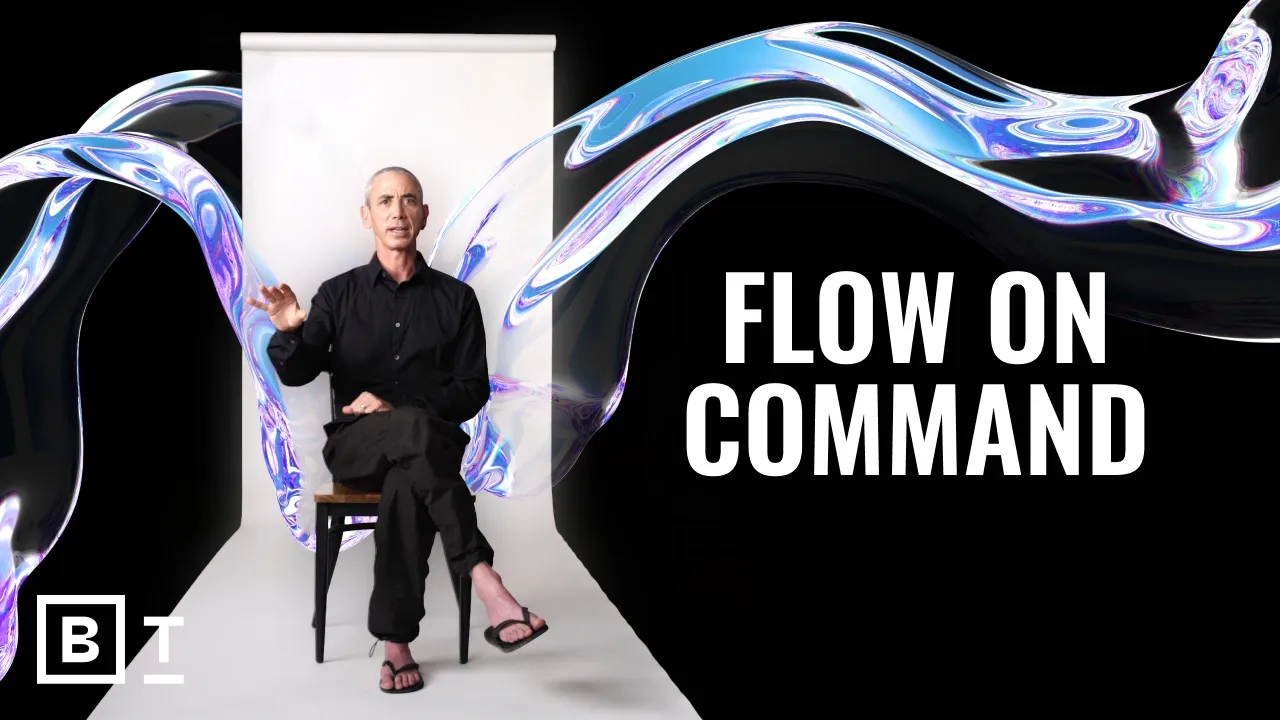
Steven Kotler begins by explaining why he prefers physiological explanations for human performance over philosophical or psychological ones. While psychology offers useful metaphors for understanding human behavior, it approaches the brain from the outside-in and is often limited by individual personality differences. Neurobiology, by contrast, offers reliable and repeatable mechanisms that work across the entire species regardless of personality.
Kotler explains that our understanding of the brain has evolved from thinking about isolated brain regions to recognizing that the brain functions through networks of regions working together. These networks can be hardwired connections or temporary functional connections that form rapidly. He introduces the concept that peak performance is about getting our biology to work for us rather than against us, specifically the biological systems underlying motivation, learning, creativity, and flow.
- Neurobiology provides more reliable and repeatable mechanisms for understanding peak performance than psychology because it works at a level common to all humans.
- The brain primarily functions through networks of regions working together rather than isolated areas handling specific functions.
- Modern neuroimaging technology has allowed us to move beyond simplified brain region models to understand complex neural networks.
- Peak performance is about aligning four key biological systems: motivation, learning, creativity, and flow.
- Flow is an optimized state of consciousness where we feel and perform our best, sitting at the sweet spot between boredom and anxiety.
In this section, Kotler provides a comprehensive definition of flow, describing it as an optimal state of consciousness characterized by six core phenomenological characteristics: complete concentration, merger of action and awareness, vanishing of self, time dilation, a sense of control, and an autotelic experience (meaning the experience is so rewarding it becomes an end in itself). These characteristics are consistent across all people, making flow a universal human experience that can be scientifically measured through 12-15 different neurobiological and physiological markers.
Kotler then introduces the concept of flow triggers - the preconditions that lead to more flow. He explains that researchers have identified 22 different triggers, all of which function by driving attention into the present moment. Some triggers work by releasing dopamine (like novelty, risk-taking, and pattern recognition), some produce norepinephrine, and others lower cognitive load. The most important trigger is the challenge-skills balance, where we enter flow when the challenge of a task slightly exceeds our skill level by about 4-5%.
- Flow has six core characteristics: complete concentration, merger of action-awareness, disappearance of self, time dilation, sense of control, and an autotelic experience.
- Flow states have 22 identified triggers that all drive attention into the present moment through various neurobiological mechanisms.
- The challenge-skills balance is the 'golden rule' of flow - we enter flow when a task challenges us slightly beyond our current skills.
- Flow requires complete focus on the present moment and can be blocked by distraction, fear, and self-consciousness.
- Factors like confidence, tolerance for anxiety, ability to delay gratification, and energy levels all influence what constitutes our 'skill level' in the challenge-skills equation.
Kotler explains the hierarchy of motivation, beginning with extrinsic motivators (like money) before moving to more powerful intrinsic motivators. He outlines five key intrinsic motivators that build upon each other: curiosity, passion, purpose, autonomy, and mastery. Each motivator in this sequence provides increasingly powerful focus with less mental effort, allowing us to conserve mental energy while maintaining high performance.
Particularly important is the progression from passion to purpose. While passion (intense interest in something) provides significant focus, purpose (connecting that passion to something greater than yourself) amplifies the benefits by triggering pro-social neurochemicals like oxytocin and endorphins. This creates a neurochemical cocktail that delivers both focus and pleasure, making purpose-driven work more sustainable and enjoyable than work driven by passion alone.
- Extrinsic motivation (especially financial security) provides the foundation for peak performance by removing basic fears.
- The five intrinsic motivators in sequence are: curiosity, passion, purpose, autonomy, and mastery.
- Purpose amplifies the benefits of passion by triggering additional pro-social neurochemicals.
- Intrinsic motivators provide 'focus for free' - attention without the high energy cost of forcing yourself to concentrate.
- Following this motivational sequence allows you to achieve more with less effort and greater enjoyment.
In this section, Kotler describes how to prepare yourself and your environment to enter flow states more reliably. He explains that the human brain naturally follows a focus cycle of 90-120 minutes, similar to our sleep cycles. To maximize flow, he recommends aligning work sessions with your circadian rhythms and blocking out 90-120 minutes of completely uninterrupted concentration by eliminating all possible distractions.
Kotler also introduces the concept of a "primary flow activity" - the activity that most reliably drops you into flow. He argues that maintaining regular engagement with your primary flow activity (whether it's skiing, playing music, or coding) trains your brain to enter flow more easily in other contexts as well. Unfortunately, many adults abandon these flow-inducing activities as they take on more responsibilities, which undermines their overall capacity for flow and peak performance.
- Flow is a focusing skill that improves with practice - the more flow you experience, the easier it becomes to enter flow states.
- The human brain has a natural focus cycle of 90-120 minutes, similar to REM sleep cycles.
- Preparing for flow requires eliminating distractions, aligning with your circadian rhythms, and creating uninterrupted work blocks.
- Everyone has a 'primary flow activity' that most reliably triggers flow states and should be maintained throughout life.
- Flow states in one domain transfer skills that make it easier to enter flow in other domains.
Kotler describes the profound performance-enhancing effects of flow states across multiple domains. Research has shown that in flow, productivity increases by up to 500%, learning speed improves by 240-500%, and creativity spikes by 400-700%. Flow also dramatically enhances overall life satisfaction and well-being, with the people who experience the most flow consistently scoring highest for overall life satisfaction.
He explains the evolutionary logic behind these enhancements: flow evolved as a response to scarcity, providing humans with the cognitive and physical tools needed to either fight/flee or cooperate/innovate to create new resources. The neurochemical cocktail produced in flow - including dopamine, norepinephrine, endorphins, anandamide, and serotonin - creates an internal state more powerful than any external drug combination could safely produce, which is why flow is so addictive and pleasurable.
- Flow states increase productivity by up to 500%, learning speed by 240-500%, and creativity by 400-700%.
- Flow produces a powerful cocktail of neurochemicals that create a euphoric state more potent than external drugs could safely replicate.
- Flow evolved as an evolutionary advantage to help humans respond effectively to resource scarcity.
- The highest level of happiness is defined as a high-flow lifestyle connected to a purpose greater than oneself.
- Flow states can be used therapeutically to override and rewrite traumatic memories, making them effective in treating PTSD and addiction.
In the final section, Kotler outlines six fundamental practices from positive psychology that prepare you for peak performance and flow. These are divided into physical and mental components. On the physical side, he emphasizes the importance of adequate sleep (7-8 hours), proper nutrition and hydration, and maintaining social support networks. These physical foundations provide the energy needed to enter flow states.
On the mental side, Kotler highlights three practices to reduce anxiety and prepare the mind for flow: gratitude practices, mindfulness meditation, and regular exercise. These practices counteract the brain's negativity bias and calm an overactive nervous system. A daily gratitude practice (taking 5 minutes to list things you're grateful for) shifts your attention from negative to positive. Just 11 minutes of mindfulness meditation or 20-40 minutes of exercise can reset your nervous system and clear cognitive load. During normal times, he recommends doing one of these practices daily; during stressful periods, two or all three may be necessary.
- Peak performance requires six basic foundations: three physical (sleep, nutrition/hydration, social support) and three mental (gratitude, mindfulness, exercise).
- Adequate sleep (7-8 hours) is non-negotiable for consistently accessing flow states.
- A 5-minute daily gratitude practice helps counteract the brain's natural negativity bias and opens the door to more novel experiences.
- Just 11 minutes of mindfulness meditation or 20-40 minutes of exercise is enough to reset an overactive nervous system.
- During periods of high stress, these practices become even more important and should be doubled or tripled.
Flow states represent one of the most powerful tools available for enhancing human performance across all domains. By understanding the neurobiological mechanisms behind flow and implementing the 22 triggers that prompt these states, anyone can dramatically increase their productivity, creativity, learning ability, and overall life satisfaction.
What makes this science particularly revolutionary is that it democratizes peak performance. Unlike approaches that rely on innate talent or personality, flow is accessible to everyone because it operates at the level of universal human biology. The research shows we are all capable of far more than we realize - not because we need to transform who we are, but because we already possess the neurobiological machinery for extraordinary performance.
So what? In a world facing increasingly complex challenges, flow science offers a pathway to unlock human potential at scale. Rather than turning to external substances or technologies to enhance performance, we can learn to harness our internal neurochemistry through specific environmental and behavioral triggers. By building these practices into our daily routines, educational systems, and organizational cultures, we can collectively elevate human capability while simultaneously increasing well-being and fulfillment.